
Secrets of Queen’s Mill
By Enda Farrell, Museum Assistant
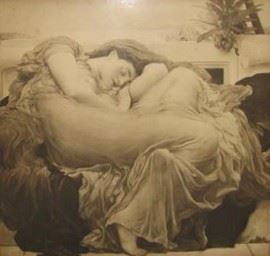
A closer look at the history behind the reproduction of Flaming June by Sir Frederic Leighton, printed by Lancaster's Rembrandt Intaglio Company in 1895 and currently hanging in the stairway of Lancaster City Museum.
In January 1839, François Arago announced Daguerre’s new photographic process to the French Academy of Sciences. While daguerreotypes produced beautifully detailed images, each was a one-off luxury. William Henry Fox Talbot, an English pioneer of photography, soon developed a negative-to-positive process that made multiple prints possible from a single exposure. Yet, these early paper prints were prone to fading, and reproducing fine photographic detail in books and newspapers remained an elusive challenge.
This rise of photography transformed the art world. Artists used photographs to study movement and landscapes, while painters began to explore qualities intrinsic to their own medium—bold colour, visible brushwork, and the freedom to interpret rather than simply record a scene. But while photography could faithfully record a painting, making that record widely and affordably available posed a massive industrial challenge. Talbot pursued a solution in the 1850’s by finding ways to print photographic images in ink, a process later advanced by Karel Klíč.
Klíč used carbon tissue—paper coated with light-sensitive gelatin—to transfer images onto copper. The gelatin controlled the depth of the etching, creating a surface that held ink with remarkable tonal depth. This was a complex multistage process.
 cropped.jpg)
The breakthrough turned commercial when Klíč partnered with Lancaster engraver Samuel Fawcett and the Storey Brothers to adapt this intaglio printing to their rotary machinery. Established in 1895 at Queen’s Mill, where Aldi now stands, the Rembrandt Intaglio Printing Company began reproducing photographs and art with unprecedented detail, making high-quality images affordable to the public for the first time.
To protect their advantage, the company kept its methods fiercely secret for over a decade. By 1900, Queen’s Mill was producing gravure prints on a massive commercial scale with virtually no direct competition. The secrecy extended deep inside the factory walls. Former employee Ernest Hampton later recalled that of the 70 to 80 workers employed in 1906, fewer than a handful understood the complete process; most were kept in the dark and paid as unskilled labourers.
Yet local talent did thrive. Sam Thompson joined the firm as a photographer after showing his work to Fawcett, eventually rising to become the company’s chief etcher. His brother William Thompson also worked there operating three cameras, the largest of these producing glass plate negatives measuring 30" x 40" (76 x 102cm).
Naturally, the secret couldn't last forever. By the early twentieth century, rivals across Europe and America mastered rotary gravure, breaking Lancaster's monopoly. The company went into decline and eventually relocated to London in 1926 and was acquired by Sun Engraving in 1932, continuing its life as Rembrandt Photogravure.
The legacy of that Lancaster innovation echoes into the twenty-first century; rotary gravure became the bedrock for printing richly illustrated mass media, including National Geographic. While modern digital Giclée inkjet printing now handles high-quality, short-run art reproductions, it was the pioneers at Queen's Mill who first proved that photographic detail, durable ink, and mass production could belong together.
.jpg)

